BLUETTI Apex 300 Reviews: See Why 0 Shoppers Rated It 0 Stars!
Before you toss it into your garage, read the 0 takes on the BLUETTI Apex 300. Is that 0/5 earned? Let’s find out.
 Supermod
  Moderator
 Recaptor
 BLUETTI Apex 300 Review: A High-Wattage Workhorse for Backup and Off-Grid Power
The BLUETTI Apex 300 is pitched as a heavy-duty portable power station designed to keep a home humming through outages, support serious DIY projects, and handle road-trip rigs without breaking a sweat. On paper, its headline numbers are eye-catching: a 2764.8 Wh capacity feeding a 3,840W inverter with up to 7,680W surge. That’s the kind of spec sheet that suggests it can start bigger appliances and run multiple essentials at once. This review of the BLUETTI Apex 300 pulls together the specs and features to paint a realistic picture of where it shines—and where you might want to think twice—before you wheel (well, carry) one into your life.
Detailed Specs & Features
At the heart of the Apex 300 sits a LiFePO4 battery known for stability and longevity. According to the spec sheet, it’s rated for 6,000 cycles, which, in plain English, means years of regular use before noticeable capacity loss. Power exits the unit through six AC ports driven by a pure sine wave inverter, two DC outputs, dual USB-A, and two USB-C ports capable of 100W Power Delivery. RV-friendly touches include Anderson support and an RV/TT-30 outlet, indicating it’s comfortable stepping into camping and van-life roles.
Charging versatility is equally ambitious. If you need a quick top-up from the grid, the Apex 300 accepts up to 3,840W AC input, translating to an estimated 70-minute full charge. Off-grid users will appreciate the 2,400W solar ceiling (with a built-in MPPT controller) and support for up to six 400W panels. There’s also car and generator input, plus dual-charging flexibility for faster turnaround when circumstances allow.
Protection and reliability boxes are well-ticked: a comprehensive Battery Management System, multiple electrical safeguards, and an UPS/EPS mode for seamless switchover during outages. For smart control, it offers app connectivity over Bluetooth and Wi-Fi, enabling remote monitoring and tuning without hovering over the screen. And for peace of mind, BLUETTI backs the unit with a lengthy 60-month warranty, which is generous in this category.
User Experience & Performance (Based on Specs)
Design & Build
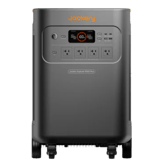
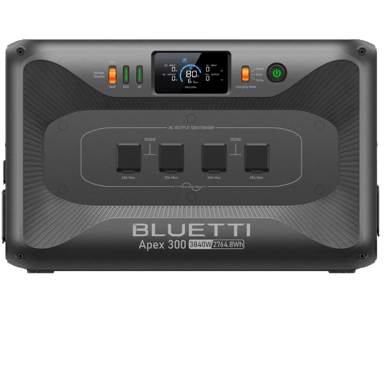
The Apex 300 comes in a boxy, industrial form factor with a matte dark-grey finish. It looks purpose-built rather than flashy, with an LCD for readouts and simple indicator lights. The big trade-off for the high power is mass: at 83.78 lbs, this is a “pick your spot and leave it there” kind of station. There are no wheels and no telescoping handle, so moving it around is a two-hands (and possibly two-person) affair. If you plan to reposition it often—say, between a garage and backyard—you’ll want to budget for a cart or dedicated spot. On the flip side, the stackable design hints at scalability for those building a larger backup ecosystem, and the overall footprint (roughly 20.7 × 12.9 × 12.6 inches) stays manageable for a shelf or van bay.
Performance
On paper, the Apex 300’s 3,840W continuous output is the headline. That’s enough, in many scenarios, to run a refrigerator, lights, networking gear, and a few mid-draw appliances—potentially all at once—so long as the total stays under the rated cap. The 7,680W surge spec provides breathing room for motor startups and power-tool spikes. If you’ve ever tripped an inverter with a miter saw kick-on, you know why this matters. The 50/60Hz support broadens its global utility, while 24V/48V and Anderson outputs expand compatibility for DC tools and rigs. And with the RV/TT-30 outlet in the mix, it’s ready to slot into camper setups without awkward adapters.
Battery longevity is another strong point. LiFePO4 chemistry is inherently durable and thermally stable. Pair that with the stated 6,000-cycle life and you’re looking at a power station that’s spec’d to outlast many electronics you’ll plug into it. Of course, “real life” depends on depth of discharge, temperatures, and how you treat the pack—but as a starting framework, it’s a reassuring number for daily solar users and frequent campers alike.
Charging & Energy Workflow
High-wattage charging means less downtime. With a max input matching the 3,840W AC limit, the advertised one-hour-plus AC fill makes sense for grid-tied preparedness: top off before a storm, or recharge quickly between outages. Solar users can push up to 2,400W into the unit; in strong sun, the spec’d 1.9 hours is aggressive but plausible under ideal conditions. The included MPPT helps squeeze more from panels as light fluctuates. There’s also car charging (helpful in a pinch) and dual-charging support, which, in practice, gives you options to optimize for time or noise.
Safety, Noise & Environmental Limits
Protection features run deep—overcurrent, short-circuit, temperature, and more—plus certification hits like UL, CE, FCC, RoHS, and UN38.3. However, the unit is rated IP20, so it’s not built for rain or dusty jobsites without shelter. Keep it dry and ventilated. Operating range is 32–104°F; if you live in a colder climate, note the lack of cold-weather charging support. Cooling is fan-based with a listed 50 dB noise level—quiet enough for a garage or utility room, but you’ll hear it in a small RV at night. There’s also a grounding/earthing requirement, which is normal for high-power systems but something to plan for in permanent or semi-permanent installs.
Smart Features
The companion app (Bluetooth and Wi-Fi) should make everyday use smoother—checking state of charge, adjusting settings, or toggling eco modes without crouching in front of the display. Firmware is upgradable via the app, which is good insurance against early quirks or the need for future tweaks. And if you’re building a home energy setup, the unit’s smart-home panel integration can help it play nicely with household circuits for targeted backup scenarios.
Pros & Cons
Pros
- Massive 3,840W continuous output with 7,680W surge for demanding loads.
- Fast turnaround: up to 3,840W AC charging; solar input up to 2,400W with MPPT.
- Durable LiFePO4 chemistry with a rated 6,000-cycle life and strong 60-month warranty.
- UPS/EPS function for seamless switchover during outages.
- RV/TT-30, Anderson support, and 24V/48V outputs broaden compatibility.
- Bluetooth/Wi-Fi app connectivity with remote control and firmware updates.
Cons
- Heavy at 83.78 lbs and no wheels or telescoping handle for easy transport.
- IP20 rating and 32–104°F operating range limit use in harsh weather and cold charging scenarios.
- Fan noise (50 dB) may be noticeable in quiet, confined spaces.
- Grounding/earthing considerations add setup complexity for home integration.
Price & Value for Money
As of this writing, the Apex 300 is listed across a few retailers at different price points. The most attractive of the prices provided is $1599 at ShopSolarKits. Value depends on how you’ll use it. If you need serious wattage, fast AC recharging, robust solar intake, and UPS functionality, the price lines up well with its capabilities. It’s particularly compelling for homeowners seeking a strong first line of outage defense, off-grid cabins with decent sun exposure, and RVers running heavier loads. If you mainly need a lightweight, carry-everywhere unit for phones and laptops, this is overkill—both in power and mass—and you’ll save money with a smaller station.
Quick Take
The BLUETTI Apex 300 reads like a home-backup specialist that won’t flinch at power-tool surges or multi-appliance juggling. It’s not the most portable “portable,” but it’s purpose-built for users who value output and recharge speed over grab-and-go convenience.
If high wattage, fast AC top-ups, and long-life LiFePO4 cells are your priorities, this spec sheet hits the right notes.
Closing Recommendation
Based on the specifications, the BLUETTI Apex 300 is best for users who want a stout, semi-stationary power hub: backup power at home, a serious RV rig, or an off-grid workshop. The lack of weather sealing and the weight are real considerations, but if you can live with those trade-offs, the combination of high output, fast charging, and long-cycle LiFePO4 chemistry makes a persuasive case.
In short: place it where you need it, wire it thoughtfully (including grounding), and let the wattage do the talking.
Verdict
Rating: Based on the specifications and overall feature set, we believe BLUETTI Apex 300 deserves 4.4 out of 5.
- Winner Feature → High 3,840W output and rapid 3,840W AC recharging deliver big-appliance confidence and quick turnarounds.
- Needs Improvement → Portability is hampered by weight and the absence of wheels; IP20 limits outdoor use without protection.
Reviews 0
The good, the bad, and the brutally honest.Average Rating


More Portable Power Stations 427
Unlock more awesome finds.